16 August 2026 · Integrity Office
A sustainable office is not defined by a few recycled chairs or a feature wall of plants. Sustainable office fitout materials need to perform under daily commercial use, suit the building, support staff wellbeing and avoid creating unnecessary waste when the workplace changes again.
For office managers, facilities teams and business leaders, the practical question is not simply, “What is the greenest material?” It is, “Which choices will serve our people and operations for the longest time, with the least environmental impact and the clearest value?” The answer depends on the space, the expected lifespan of the fitout, maintenance requirements and the ability to reuse or adapt what is already there.
Start with the material already in the office
The most effective sustainability decision is often to retain a useful element rather than replace it. Existing ceilings, partitions, workstations, joinery and floor finishes may be refreshed, reconfigured or repaired instead of removed. This reduces demolition waste, shortens lead times and can preserve budget for upgrades that will make a real difference to how the workplace operates.
That does not mean keeping everything. A tired reception counter may no longer reflect the business, and old partitions can limit collaboration, privacy or accessibility. The point is to assess each item on its condition and future usefulness, rather than treating every refurbishment as a clean slate.
A thorough site review should identify what can be retained, relocated, refinished or donated. It should also consider concealed services and building constraints before new materials are specified. Reusing a component only makes sense when it remains safe, functional and cost-effective to maintain.
Sustainable office fitout materials worth specifying
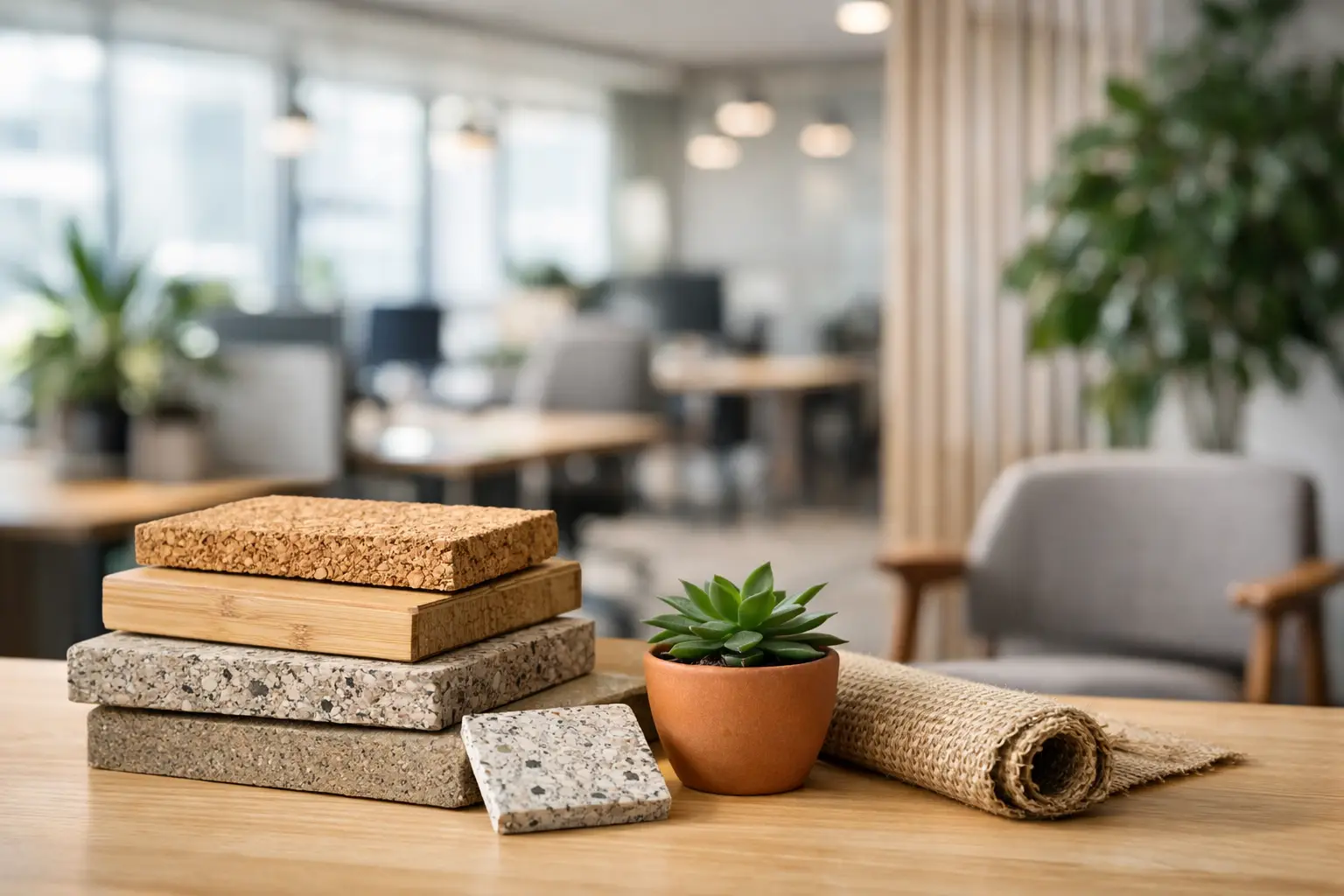
Material selection works best when environmental credentials and commercial performance are considered together. Products should be appropriate for the traffic, cleaning regime, acoustic needs and expected life of each area.
Low-emission paints, adhesives and sealants
Paints, glues, sealants and coatings can have a significant effect on indoor air quality, particularly during and immediately after a fitout. Selecting low-VOC products can help reduce unpleasant odours and minimise the release of volatile organic compounds into the workplace.
This is particularly relevant for businesses returning staff to an occupied office soon after works are complete. Low-emission products are a sensible consideration in meeting rooms, quiet rooms, healthcare settings and education environments, but they should be paired with a realistic installation and ventilation plan. A product label alone cannot compensate for poor site management.
Recycled and recyclable flooring
Flooring must withstand heavy foot traffic, chair movement, spills and regular cleaning. Carpet tiles are often a practical option because damaged sections can be replaced individually rather than requiring an entire floor to be removed. Many ranges also incorporate recycled content and offer manufacturer take-back programs at the end of their useful life.
For hard flooring, consider durability, repairability and the source of the raw materials. Timber-look vinyl may suit high-use areas where cleaning and resilience are priorities, while responsibly sourced timber can add warmth in reception or client-facing spaces. Neither choice is automatically better. The right option depends on the room’s use, the maintenance program and how long the finish is likely to remain in place.
Certified timber and timber alternatives
Timber is widely used in joinery, workstations, wall panelling and tables because it is adaptable and visually enduring. Look for responsibly sourced timber and engineered boards with low formaldehyde emissions. This is especially important for custom joinery, where large surface areas of board products may be installed throughout a workplace.
Reclaimed timber can create a distinctive result and reduce demand for virgin materials, although it may carry added cost due to sourcing, preparation and finishing. For some projects, a durable laminate or veneer on a low-emission substrate offers better budget control while still delivering a professional finish.
Furniture designed for repair and reuse
Office furniture is one of the clearest opportunities to reduce waste. Well-made task chairs, desking and storage can outlast several lease cycles when components such as castors, arms, upholstery, screens and worktops can be repaired or replaced.
When comparing furniture, ask about warranty periods, availability of spare parts and whether the product can be disassembled at end of life. A cheaper workstation that cannot be modified when teams grow or move may become a false economy. Modular systems are particularly useful for organisations anticipating changes in headcount, hybrid work patterns or future relocations.
Recycled-content acoustic materials
Acoustic panels, desk screens and ceiling treatments can improve speech privacy and reduce distraction in busy workplaces. Products made with recycled PET or recycled textile content are increasingly available in a broad range of colours and formats.
Acoustic performance should be verified against the needs of the space. A decorative panel may look effective but provide limited sound absorption if it is too thin, poorly positioned or installed in insufficient quantity. The best result comes from planning acoustics alongside the layout, ceiling, flooring and partition strategy.
Look beyond recycled content
Recycled content is useful, but it is only one measure of a material’s impact. A product may contain recycled material yet be difficult to repair, impossible to separate into components or unsuitable for the demands of a commercial office.
A more useful assessment considers the full working life of the product: where it comes from, how it is made, how far it travels, how it performs, how it is maintained and what happens when it is no longer needed. Locally manufactured products can reduce transport requirements and make replacement parts easier to obtain, although local supply should still be assessed for quality, cost and environmental documentation.
For larger projects, environmental product declarations, responsible sourcing certifications and supplier take-back arrangements can provide greater confidence than broad marketing claims. Your fitout partner should be able to explain what those credentials mean in practical terms, rather than simply adding a sustainability label to a specification.
Design for change, not just handover day
Businesses rarely stay static. Teams expand, working styles change and lease requirements evolve. A fitout that can be adjusted without major demolition is generally more sustainable than one built around fixed, single-purpose elements.
Demountable partitions can allow offices and meeting rooms to be reconfigured. Modular furniture can move with the business. Loose furniture, rather than permanently fixed built-in seating, may be reused in another location. Even simple decisions, such as standardising workstation sizes and selecting readily available finishes, can make future alterations less wasteful.
There is a balance to strike. Highly flexible systems can cost more upfront, and not every workplace needs them. A specialist medical practice, for example, may require more permanent infrastructure than a growing professional services business. The objective is to invest in flexibility where change is likely, not to pay for it where it adds little value.
Manage waste during construction
Sustainable choices can be undone by poor construction planning. Packaging, offcuts, removed furniture, old carpet and redundant fixtures all need a clear pathway before work begins. Separating materials for reuse, recycling or responsible disposal is more effective than sorting through mixed rubbish after the project is complete.
Careful measurement and coordinated procurement also reduce avoidable waste. Ordering accurately, selecting standard sheet sizes for joinery where suitable and protecting installed finishes from damage can prevent costly rework. These details are less visible than a recycled feature panel, but they are often where responsible delivery has the greatest impact.
For occupied workplaces, staging works can also reduce disruption and prevent otherwise serviceable furniture or equipment from being damaged during a rushed move. A single point of project accountability helps ensure design decisions, site access, trades and waste management are coordinated rather than treated as separate tasks.
Build sustainability into the brief
The best time to make material decisions is before design is locked in. Set clear priorities at the briefing stage: retain existing assets where practical, improve indoor air quality, reduce waste, select durable furniture or support a particular environmental rating target. Not every project will pursue all of these goals, and being clear about priorities helps avoid unnecessary cost or compromise later.
At Integrity Office, this process starts by understanding how the workplace needs to function, then aligning the design, materials, budget and construction plan around that outcome. For Melbourne businesses, that practical coordination can make sustainability easier to deliver without adding complexity to an already demanding relocation or refurbishment.
A considered fitout should leave your business with more than an attractive office. Choose materials your team can maintain, adapt and use with confidence, and the environmental benefits will continue well beyond the day the space is handed over.