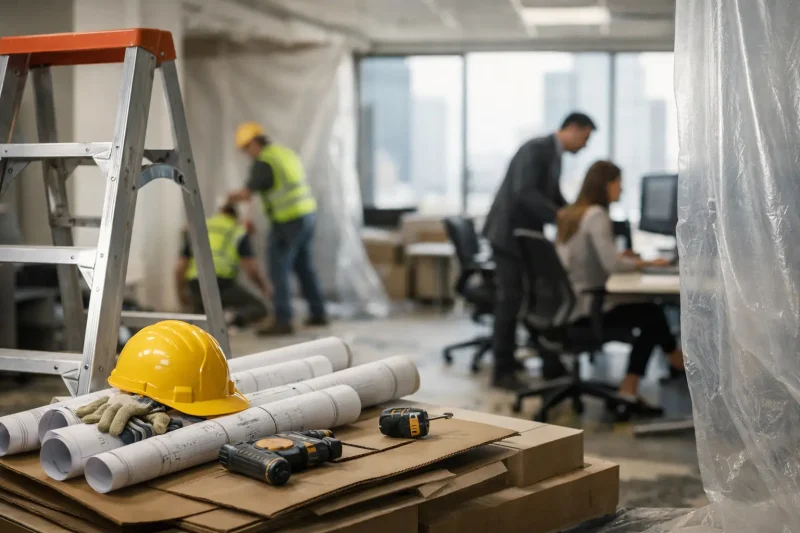
If your lease start date is locked in, your team is growing, or your current space is holding the business back, timing stops being a nice-to-have and becomes a business risk. That is why office fitout timeline expectations matter early. The right question is not simply, how long will it take? It is, what needs to happen, in what order, and what could shift the programme?
For most businesses, a commercial office fitout is not delayed by one dramatic issue. It is usually the smaller decisions, approvals and supply items that add up. A realistic timeline gives you room to make good choices without creating avoidable pressure on your people, your landlord or your operations.
What realistic office fitout timeline expectations look like
A typical Commercial office fitout can take anywhere from 6 to 16 weeks once design is underway, but that range only makes sense when you understand the project type. A light refurbishment with paint, flooring, furniture and minor cosmetic updates may sit at the shorter end. A full fitout with demolition, new services, partitions, joinery, feature areas and landlord approvals will usually take longer.
The planning stage often gets underestimated. Before any construction starts, there may be site inspections, test fits, concept design, budgeting, authority checks, landlord review, building management requirements and documentation for permits. In many cases, this pre-construction phase can take as long as the build itself.
That is why experienced project teams talk about total project timeframe rather than construction alone. If you only measure the time trades are on site, you can end up with the wrong expectation from the beginning.
The stages that shape the timeline
Briefing and site assessment
This is where the project becomes practical. Your team defines what the space needs to achieve, how many people it must support, what departments need adjacencies, and whether the workplace should reflect a stronger brand identity or support a different style of working.
At this point, site constraints often emerge. Base building services, existing tenancy conditions, ceiling heights, access hours and make-good obligations can all influence the programme. A clear brief speeds up the next stage. A vague brief usually means revisions later.
Design and budget alignment
Concept design can move quickly if decision-makers are aligned. It slows down when there are multiple internal stakeholders, uncertain headcounts or a mismatch between the design ambition and available budget.
This is also where trade-offs become real. For example, custom joinery may better suit your brand and storage needs, but it can add lead time compared with standard products. Acoustic treatments, meeting room technology and specialist finishes can all improve the end result, but they need to be selected early enough to avoid delays.
Approvals and documentation
For many commercial office projects, this is the least visible stage and one of the most important. Depending on the building and scope, you may need landlord approval, building management sign-off, compliance documentation, and permits for certain works.
In occupied buildings, there may also be strict rules around after-hours access, loading dock bookings, lift protection and noisy works. None of these items are unusual, but they do affect sequencing. In Melbourne CBD buildings in particular, access logistics and building rules can add time if they are not accounted for from day one.
Procurement and lead times
Not every item is sitting in a local warehouse ready for delivery. Workstations, task chairs, feature lighting, glazing, carpet tiles, custom joinery and imported finishes can all carry different lead times. If furniture and construction are procured separately without coordination, the programme can easily become fragmented.
This is one reason many clients prefer a single project partner. When design, build and furniture are coordinated together, lead times can be checked against the construction programme rather than treated as a separate issue later.
Construction and installation
Once works begin on site, the timeline depends on scope, sequencing and access. A straightforward internal refresh may move quickly. A full fitout involving demolition, electrical, data, mechanical changes, partitioning, ceilings, flooring, joinery and furniture installation requires more careful coordination.
Construction rarely works like a simple checklist. One trade often relies on another to finish first. If a ceiling layout changes, lighting and sprinkler locations may change too. If a joinery detail is revised late, wall finishes and services coordination may also shift.
Defects, commissioning and handover
The job is not finished when the last chair arrives. Meeting rooms need to function properly, services need to be tested, and any final touch-ups should be completed before staff move in. A proper handover period helps avoid a rushed first week in the new space.
What causes office fitout timelines to blow out
The biggest cause is delayed decision-making. When finish selections, layout approvals or furniture choices drift, procurement and site works are affected. Even a short delay at the wrong point can have a wider impact on the programme.
The second common issue is incomplete early planning. If teams move into documentation before the brief, budget or site constraints are fully understood, changes tend to happen later when they are more disruptive and costly.
The third is approval complexity. Landlords, building managers and compliance requirements are not obstacles, but they do require time. Treating approvals as a formality instead of a project stage often leads to unrealistic expectations.
Supply chain variation also matters. Some products are readily available, while others are made to order. If your programme depends on a key item with a long lead time, that decision should be made early or substituted with a more available option.
Then there is the human factor. Businesses are still running while fitouts are being planned. Stakeholders go on leave, internal priorities shift, and project decisions compete with day-to-day operations. A realistic timeline should account for this rather than assume instant turnaround on every approval.
How to keep your fitout on programme
Start earlier than you think you need to. If you have a lease expiry, relocation date or staff growth milestone ahead, work backwards with enough margin for design, approvals and procurement. Leaving it late usually reduces options and increases pressure.
Choose a project partner that can provide clear staging, not just a broad estimate. Good programmes show what happens first, what depends on prior approvals, and where the risk points are. They also explain what the client needs to decide and by when.
Keep decision-making tight. That does not mean rushing important choices. It means agreeing who signs off layouts, finishes, budget variations and furniture selections before the project starts.
Be honest about priorities. If speed is the top priority, some custom elements may need to be simplified. If brand impact is critical, the programme may need to allow for bespoke joinery or specialised finishes. Neither approach is wrong, but the timeline should match the objective.
A fixed-price, end-to-end approach can also help reduce programme drift. When design, approvals, construction and furniture are managed together, accountability is clearer and coordination is stronger. That tends to produce fewer surprises than splitting responsibilities across multiple providers.
How long should you allow for different fitout types?
A minor refresh may only need several weeks of planning and a short site programme if the scope is mostly cosmetic and products are available locally. A mid-range refurbishment with some partitioning, services adjustments and new furniture often needs a longer runway, particularly if the office remains partly occupied.
A full office fitout should be approached as a staged project rather than a quick upgrade. Once concept design, landlord approvals, documentation, procurement, construction and handover are considered together, the timeline becomes more substantial. That is normal. What matters is not promising an unrealistically fast outcome, but delivering a well-managed one.
For organisations in government, education and healthcare, the timeline can stretch further because internal governance, procurement processes and compliance reviews are often more detailed. These projects benefit from especially clear programme management and stakeholder communication.
The best timeline is the one you can trust
Fast is appealing, but credible is better. A realistic programme gives your business the ability to plan relocation dates, staff communications, IT cutover, operational continuity and budget with confidence. It also gives the project team a fair chance to deliver quality without unnecessary shortcuts.
At Integrity Office, we have seen that the smoothest projects are not always the shortest. They are the ones where expectations are set properly, responsibilities are clear, and the programme reflects the real work involved. you’re most welcomed to visit our showroom to discuss your timeline with us.
If you are planning a fitout, treat the timeline as a project tool, not a sales promise. The right expectation at the start makes the whole process easier to manage and far more likely to finish the way it should – on time, on budget and ready for your team to get on with work.
Next step
Find out what your fitout costs.
One team for design, construction, joinery and furniture. One contract, one fixed price, and one person to hold us to it.