
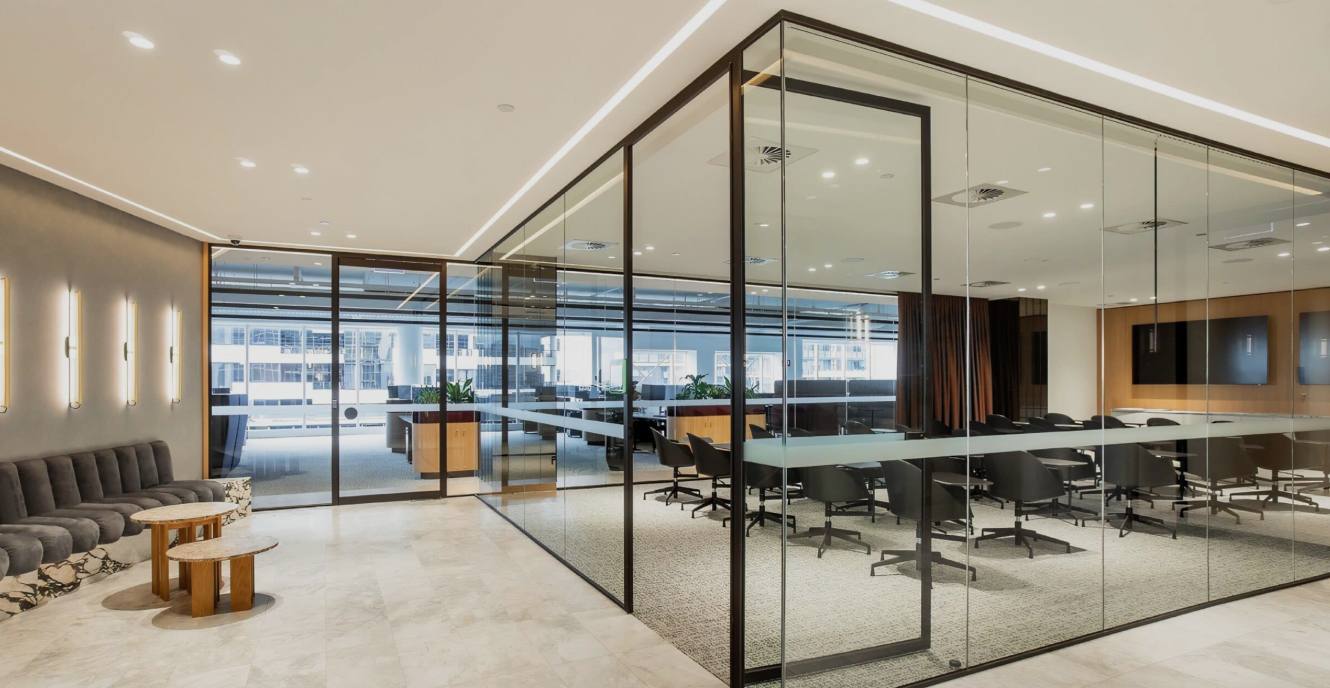
Office Fitouts That Work for Your Business
Melbourne office fitouts since 1985 3,500+ workplaces Fixed price 5.0 from 36 Google reviews
A cramped meeting room, patchy acoustics and nowhere for quiet work usually show up long before a lease expires. By the time a business starts looking at office fitouts, the issue is rarely just appearance. It is usually about productivity, capacity, staff experience and whether the space still fits the way the organisation works.
That is why a fitout needs to be approached as a business decision, not simply a design exercise. A well-planned workplace can support better collaboration, clearer workflows and a stronger day-to-day experience for staff and visitors. A rushed one can create disruption, cost more than expected and leave you with a space that looks fresh but functions poorly.
What office fitouts should actually achieve
The best office fitouts do more than replace carpet tiles and add a new reception desk. They solve practical problems. For some organisations, that means making room for growth without taking on extra floor area. For others, it means improving client-facing spaces, updating tired finishes or creating a layout that suits hybrid work.
There is no single formula because every business uses space differently. A finance team handling focused work will need something different from a creative studio or a healthcare administration office. Even within the same sector, priorities can vary. One business may care most about acoustic privacy, while another needs more informal meeting areas or better storage.
A good fitout starts by identifying what is not working now. That might be poor circulation, underused breakout areas, dated furniture, limited meeting space or a layout that no longer reflects the company’s culture. Once those issues are clear, design and construction decisions become much easier to justify.
Why planning matters more than finishes
It is easy to get drawn into the visible parts of a project such as joinery, colour schemes and feature walls. Those details matter, but they should come after the bigger decisions. Space planning, services coordination, compliance and staging tend to have more impact on the overall result than any single finish selection.
The most successful projects usually have a clear brief from the outset. That brief should cover headcount, team adjacencies, technology needs, storage, accessibility, brand requirements and budget. It should also deal with timing. If your team needs to stay operational during works, staging and site management become critical.
This is where many businesses run into trouble. They assume the project is mainly about design, then discover too late that approvals, landlord requirements and building rules affect both cost and program. In commercial environments, those details are not secondary. They shape what can be delivered and how smoothly the project runs.
The real cost question in office fitouts
Most decision-makers are not asking for the cheapest option. They are asking for certainty. Cost overruns, vague allowances and scope gaps create stress because they make planning difficult. That is especially true for CFOs, operations teams and office managers who need a project to stay controlled from start to finish.
The total cost of office fitouts depends on several factors, including the quality of finishes, the amount of demolition required, mechanical and electrical changes, custom joinery, furniture and the condition of the base building. A light refresh is very different from a full strip-out and rebuild.
What matters is understanding where the budget is going and whether those investments improve the way the business operates. Spending more on acoustic treatment may be worthwhile if noise is affecting performance. Investing in quality task seating may reduce complaints and improve comfort across the team. On the other hand, expensive design features with little day-to-day benefit may not be the best use of funds.
A fixed-price delivery model can help remove uncertainty, provided the scope has been properly defined. It is not about squeezing a project into an unrealistic number. It is about setting expectations early, identifying inclusions clearly and reducing surprises once work begins.
Choosing the right office fitout approach
Not every project needs a complete transformation. In some workplaces, a refurbishment can deliver strong results without the cost or downtime of a full rebuild. Reusing quality furniture, retaining parts of the existing layout or upgrading selected areas may be enough to achieve a better outcome.
In other cases, a more comprehensive fitout makes sense. That is often true when a business is relocating, consolidating teams, changing its work model or dealing with a space that no longer meets compliance or operational needs. Starting fresh can provide better long-term value if the current layout is fundamentally wrong.
There is also a middle ground. Many organisations benefit from a staged approach, especially if they need to stay open during works. Reception and client-facing spaces might be tackled first, followed by work areas, meeting rooms and breakout zones. This can reduce disruption, although staged projects can take longer and require tighter coordination.
The right path depends on budget, timeframes, lease conditions and how much change the business actually needs. A practical fitout partner should be able to explain those trade-offs clearly rather than pushing a one-size-fits-all solution.
What a smooth project delivery looks like
For most clients, the easiest projects are the ones that feel well managed. Communication is consistent, responsibilities are clear and there is one accountable point of contact throughout the process. That matters because fitout projects often involve more moving parts than expected.
There may be designers, trades, furniture suppliers, building management, certifiers and IT providers all working to the same deadline. Without strong coordination, delays and missed details can creep in quickly. A simple example is power and data placement. If these are not aligned with furniture plans early, the result can be expensive rework or awkward compromises after installation.
Smooth delivery also depends on realistic programming. Promising an overly ambitious handover date might sound appealing, but if it leads to rushed works or unresolved defects, it does not help the client. Businesses generally want speed, but they also want confidence that the job will be finished properly.
That is one reason many organisations prefer an end-to-end model. Having one team manage design, construction, furniture, approvals and final handover reduces fragmentation and helps keep the project aligned. It also gives the client a clearer line of accountability if questions come up along the way.
Designing for people, not just floorplans
A workplace can meet every technical requirement and still feel wrong. That usually happens when a fitout focuses only on density or appearance without considering how staff actually use the space.
People need a mix of settings to do their best work. Quiet zones support concentration. Informal areas encourage quick conversations. Meeting rooms need the right technology and acoustics. Storage should be accessible without taking over valuable floor area. Even basic details such as lighting, wayfinding and furniture ergonomics affect how comfortable and productive a team feels.
Culture matters as well. Some businesses want a polished, corporate feel. Others need something warmer and more relaxed. Neither approach is automatically better. The key is making sure the environment reflects the organisation and supports the way people work.
For businesses across Melbourne, this often means balancing flexibility with practicality. Teams may be in the office fewer days per week than they once were, but that does not mean office space is less important. If anything, it needs to work harder by supporting collaboration, hosting clients professionally and giving staff a reason to enjoy being there.
How to judge whether a fitout partner is right
Experience matters, but not just in years. What matters is whether a provider understands commercial realities such as budgets, deadlines, stakeholder management and live-site constraints. A good portfolio is useful, but so is evidence that projects were delivered professionally and with minimal fuss.
It is worth asking how the process is managed, who takes responsibility for approvals, how variations are handled and what happens after handover. Some providers are strong on design but light on delivery. Others can build efficiently but offer limited strategic guidance at the front end. The best fit is usually a partner who can bridge both sides of the project.
Clients also benefit from straight answers. If the timeframe is tight, say so. If the budget does not match the brief, address it early. If a staged delivery would reduce disruption, explain why. That level of transparency builds trust and usually leads to better decisions.
Integrity Office has built its reputation on that kind of practical, accountable delivery – helping businesses create workplaces that are tailored, functional and easier to deliver than they expected.
A fitout should leave you with more than a better-looking office. It should give your business a space that supports the work ahead, feels right for your people and makes daily operations easier, not harder.