
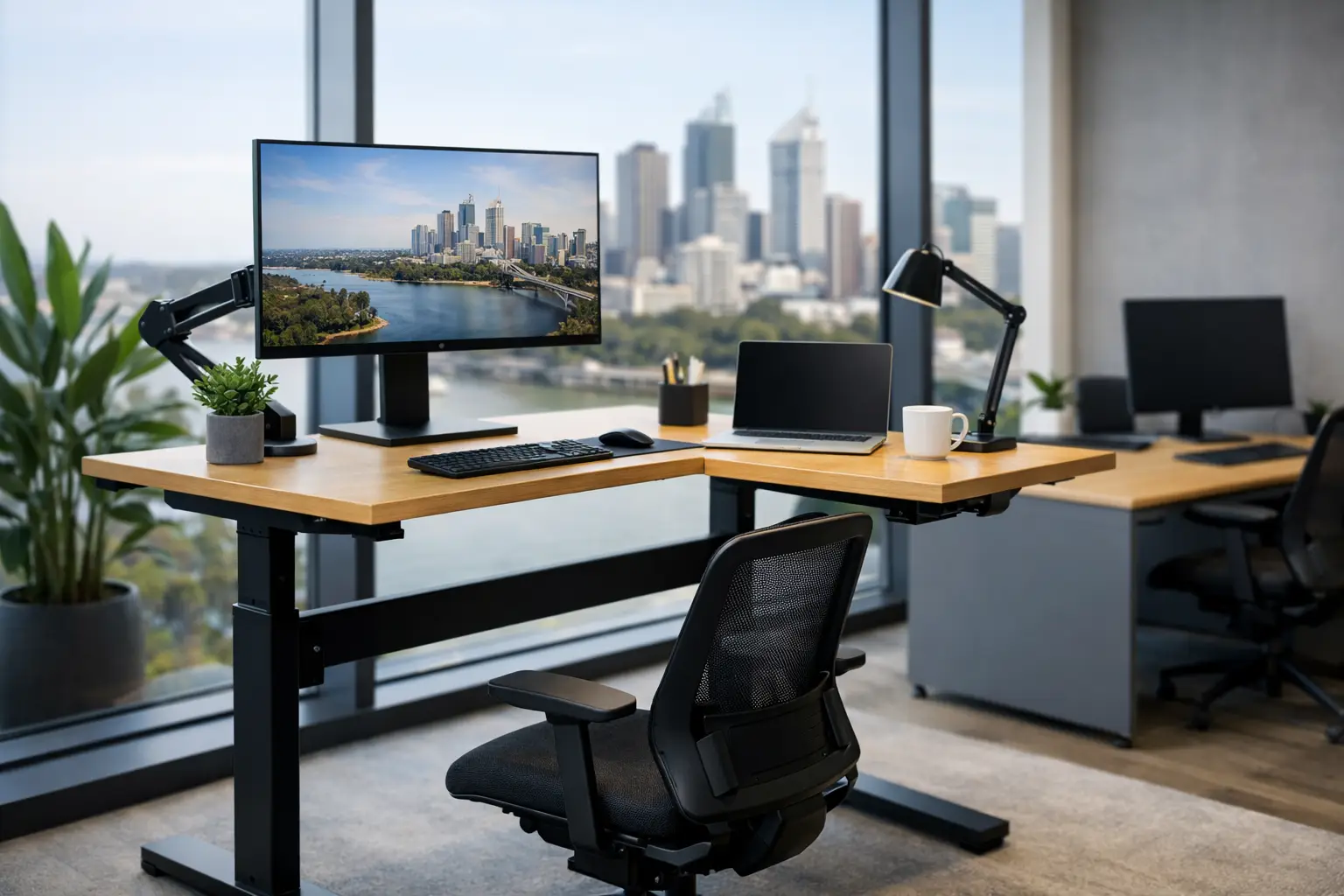
Sit Stand Desk Review for Australian Offices
When a team starts complaining about stiff backs by 3 pm, or managers notice people drifting away from their desks to take calls standing up, the furniture is usually telling you something. A good sit stand desk review is not really about whether height-adjustable desks are trendy. It is about whether they suit the way your workplace actually operates, day after day.
For Australian businesses, that question matters more than the marketing. A sit stand desk can improve comfort, support movement and help modernise a workspace, but only when the desk is well specified, properly installed and matched to the people using it. Buy the wrong one and you can end up with wobble, cable mess, frustrated staff and a product that looked better in the brochure than it does on the floor.
What a sit stand desk review should actually assess
Many reviews focus on surface-level features such as memory presets or USB charging ports. Those features can be useful, but they are not what determines long-term value in a commercial setting. What matters first is structural quality, lifting performance, ergonomic range and how the desk fits into the broader workplace.
In practice, the best height-adjustable desks do four things well. They move smoothly, stay stable at working height, accommodate different users and hold up under daily use. That sounds straightforward, but there is a considerable difference between a desk that works well for one person in a home office and one that can handle years of use in a busy commercial environment.
If you are reviewing desks for an office fit-out, refurbishment or furniture replacement, it also pays to look beyond the individual workstation. Cable management, workstation layout, acoustic impact, shared desk use and floor loading can all influence whether a sit stand solution performs properly once the office is occupied.
Sit stand desk review: the key strengths
The strongest case for sit stand desks is flexibility. In workplaces with mixed roles and mixed body types, fixed-height desks often force compromise. A height-adjustable desk gives staff more control over their position throughout the day, which can reduce discomfort and support better ergonomic setup.
That does not mean standing all day is the goal. In fact, the benefit usually comes from variation rather than constant standing. Users can alternate between seated and standing work depending on the task, energy level and physical needs. For many businesses, that makes these desks particularly useful in roles involving concentrated computer work, frequent calls or long periods at a screen.
They also make sense in hybrid environments and hot-desk settings. When different people use the same workstation, a desk that adjusts quickly is far more practical than trying to accommodate everyone with one fixed height. Add monitor arms and an appropriate chair, and the workstation becomes much easier to tailor to each user.
From a design perspective, sit stand desks can also support a more contemporary office. They signal investment in staff wellbeing and can align well with workplace strategies that prioritise flexibility, movement and user choice. For organisations upgrading older offices, that can be part of a broader shift in how the space is perceived and used.
Where sit stand desks can fall short
The trade-offs are real, and a balanced sit stand desk review should be clear about them.
First, not every employee will use the standing function regularly. Some people adopt it straight away. Others use it for a few weeks and then leave the desk in one position. That does not automatically make the purchase a poor one, but it does mean utilisation can vary across teams.
Second, lower-quality desks can become unstable at taller heights. This is one of the most common issues in cheaper models. A desk may feel fine when seated, then noticeably wobble once raised, especially with dual monitors, laptop docks or heavy equipment on top. In a commercial office, that can quickly undermine confidence in the product.
Third, there is the issue of noise and speed. In a quiet workplace, motors that sound acceptable in a showroom can be distracting when 20 desks move at once. A desk that adjusts too slowly can also be irritating for users who want quick transitions between tasks.
Then there is cost. Sit stand desks are typically more expensive than fixed-height alternatives, and the cost does not stop at the frame. You may also need better cable management, monitor arms, power integration and more careful space planning. If the desks are being introduced across a large office, those details affect both budget and delivery.
What to check before you buy
Height range and user suitability
The desk should suit the people who will use it, not an average user from a product sheet. Check the full height range and whether it supports both shorter and taller staff comfortably. This is particularly important in shared workstations, education settings and workplaces with diverse teams.
Stability under load
Ask what the desk is like at maximum practical working height, not just at its lowest setting. Consider the real load on the desk including monitors, docking stations, task lighting and personal equipment. A desk with a decent stated weight rating can still feel unstable if the frame design is poor.
Motor quality and adjustment speed
A smooth, reasonably quiet motor matters more in open-plan offices than many buyers expect. The adjustment should feel controlled, with no jerking or strain. Dual-motor systems are often preferable for commercial applications because they tend to provide more consistent lifting performance.
Desktop size and workspace planning
The right top size depends on the role. Administration staff, designers and finance teams may all use their workstations differently. Too small and the desk feels cramped. Too large and you can compromise circulation space or create unnecessary cost. The desk should support the work being done while fitting neatly into the overall office layout.
Cable management
This is where many installations come unstuck. A moving desk needs cabling that moves with it safely and neatly. Without proper trays, baskets or flexible cable systems, you end up with hanging leads, trip hazards and an untidy finish. In a client-facing office, that matters.
Warranty and service support
A longer warranty is helpful, but only if the supplier can back it up. For commercial buyers, responsiveness matters. If a desk fails in an occupied office, delays in replacement parts or service can become a genuine operational issue.
Is a sit stand desk worth it for every office?
Not always. The best answer depends on your workforce, budget and how the office is used.
If your workplace has fixed desks, low staff turnover and limited screen-based work, a full sit stand rollout may not be the highest-value upgrade. In those cases, ergonomic seating, better monitor positioning or improved workstation layout might deliver stronger results for less cost.
On the other hand, if your office is being refurbished, your teams are largely desk-based, or your workplace strategy includes flexibility and shared workpoints, sit stand desks can be a worthwhile investment. They are especially effective when planned as part of a wider furniture and fit-out solution rather than treated as a standalone product decision.
That broader view is often where businesses get the best outcome. A desk might be excellent on its own, but if it clashes with storage, power access, meeting spaces or circulation paths, the overall workplace suffers. In our experience, the most successful installations happen when furniture selection, space planning and service coordination are considered together from the outset.
A practical sit stand desk review for decision-makers
If you are comparing options for a commercial office, it helps to think in terms of risk reduction as much as product features. The right desk should reduce ergonomic compromise, support a cleaner setup and integrate into the way your office functions. The wrong desk creates maintenance issues, user frustration and additional cost later.
For office managers and operations leaders, reliability is usually the deciding factor. For HR and people teams, user comfort and flexibility tend to carry more weight. For finance teams, whole-of-life value matters more than entry price alone. A useful sit stand desk review should speak to all three.
That is why showroom impressions only tell part of the story. Before making a final decision, ask how the desk performs over time, how it handles commercial use, what support is available after installation and whether it genuinely suits your workplace strategy. A cheaper desk that needs attention in year two is rarely cheaper in practice.
For Melbourne businesses planning an upgrade, this is often one of those choices that looks simple until it affects every workstation on the floor. Getting it right can improve comfort, functionality and the day-to-day experience of the office. Getting it wrong tends to show up quickly, and not in ways staff are shy about mentioning.
The better question is not whether sit stand desks are good or bad. It is whether the specific desk you are considering is fit for purpose, properly supported and appropriate for the people who will use it every day. Start there, and the buying decision becomes much clearer.