
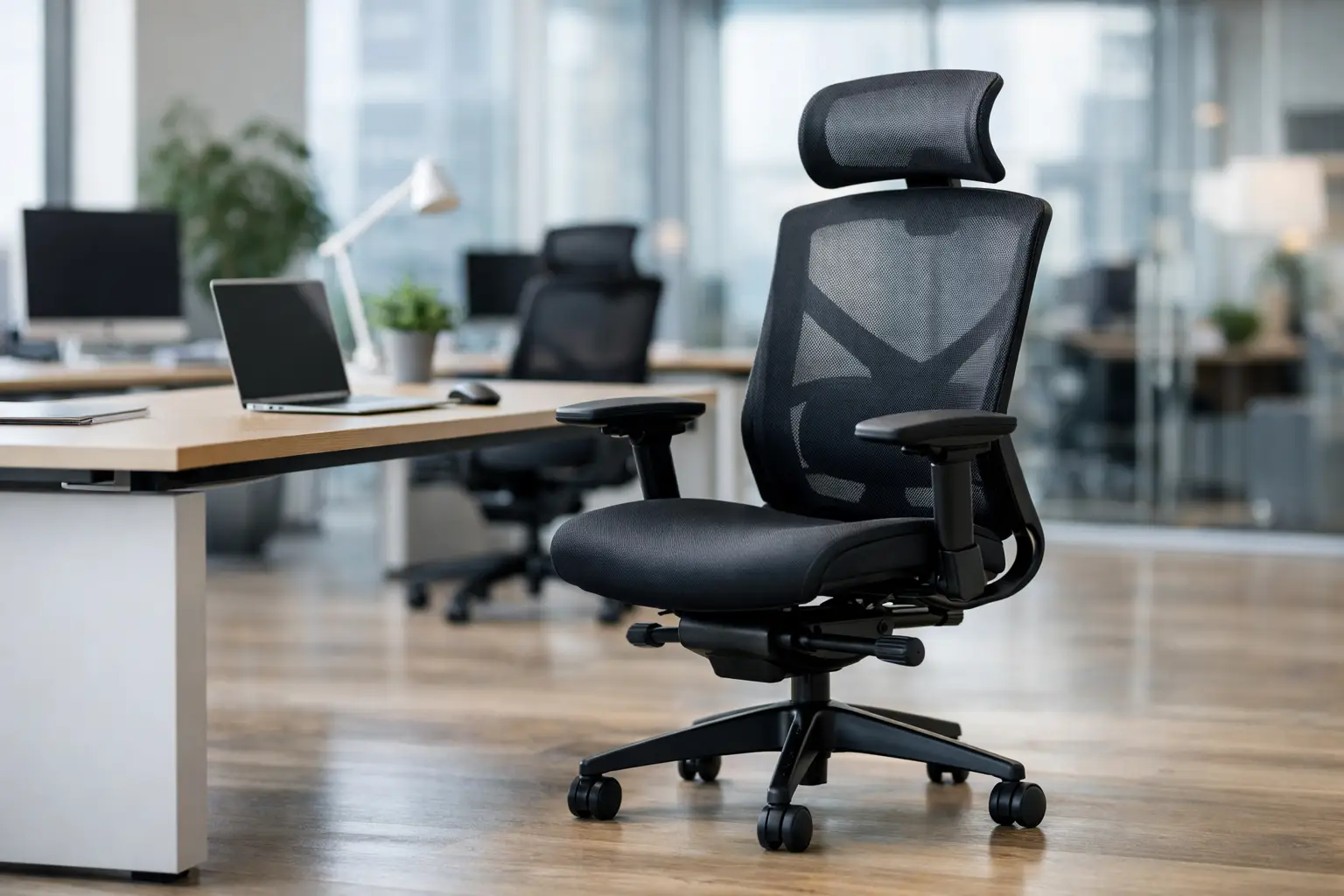
Ergonomic Office Chair Review for Workplaces
Melbourne office fitouts since 1985 3,500+ workplaces Fixed price 5.0 from 36 Google reviews
When a chair is wrong, people notice it by 3 pm. You see more shifting, more standing meetings that were not meant to be standing meetings, and more low-level complaints about backs, shoulders and concentration. That is why an ergonomic office chair review should never be treated as a box-ticking exercise. For most businesses, seating affects comfort, productivity, presentation and the long-term value of a fit-out.
A chair can look impressive in a showroom and still be a poor fit once it is used for eight-hour days across different body types and work styles. The real question is not whether a chair has lots of levers and marketing claims. It is whether it can support the people using it, in the way they actually work.
What an ergonomic office chair review should assess
The best reviews look beyond appearance and price. In a commercial setting, you are judging a chair on how well it performs over time, how easily it can be adjusted by different users, and how well it fits the broader workplace.
Seat height is the starting point, but it is rarely the deciding factor. A better review looks closely at lumbar support, seat depth, backrest movement, armrest adjustment and the quality of the mechanism. If those elements do not work together, even an expensive chair can feel tiring after a few hours.
Lumbar support matters because lower back discomfort is one of the first issues people raise when seating is poorly specified. Good lumbar support should feel present without being intrusive. If it is too firm or fixed in the wrong position, users tend to perch forward or avoid the backrest altogether, which defeats the purpose.
Seat depth is often overlooked in standard purchasing decisions. A deep seat can be uncomfortable for shorter users because it presses behind the knees or stops them using the backrest properly. A seat that is too shallow may leave taller users feeling unsupported. In shared workplaces, seat slide adjustment is often worth having because it helps one chair suit a wider range of staff.
Backrest movement also deserves attention. Chairs that recline too freely can feel unstable, while chairs with very stiff tension can encourage static sitting. A well-designed chair allows movement without losing support. That matters because posture is not about sitting perfectly still. It is about allowing small changes in position throughout the day.
Ergonomic office chair review criteria that matter in practice
In theory, more adjustment sounds better. In practice, too many controls can lead to confusion, misuse and wasted spend. Most teams do not want a chair that needs an instruction manual every time someone sits down.
The strongest commercial seating choices usually balance adjustability with simplicity. Users should be able to set the basics quickly and understand what each control does. If a chair is technically excellent but no one can adjust it properly, its ergonomic value is limited.
Material choice also changes the result. Mesh backs can improve airflow and suit warmer environments, but not all mesh provides the same support. Some cheaper mesh chairs feel fine at first and then lose tension over time. Upholstered backs can provide a softer, more consistent feel, though they may hold heat more readily. Neither is automatically better. It depends on the workplace, the level of daily use and the expected lifespan.
Armrests are another area where reviews should be realistic. Adjustable armrests can reduce strain for some users, particularly at keyboard-intensive workstations, but bulky armrests can also get in the way of desks or meeting tables. In some environments, fixed or minimal armrests are the smarter option. This is one of those decisions where the task matters as much as the feature list.
Why one chair rarely suits every team
A common mistake in office furniture procurement is trying to find a single chair for everyone. That can work in some settings, but not all. A finance team seated for long stretches may need different support from a collaborative project team that moves between desks, meeting rooms and breakout spaces.
Body size, task type and desk setup all influence what will feel comfortable. Hot-desking adds another layer again, because the chair needs to be intuitive enough for multiple users. Executive offices, focus areas, call centres and reception points often require different seating responses, even within the same fit-out.
This is where an ergonomic office chair review becomes more useful as a decision-making framework than as a simple ranking. Rather than asking which chair is best, ask which chair is best for this group, this task and this environment. That shift usually leads to better purchasing decisions.
The trade-off between price and whole-of-life value
Budget matters. Every business has to weigh cost against broader project priorities. But with task seating, the cheapest option often becomes expensive in other ways.
Lower-cost chairs may have shorter warranties, less durable mechanisms and poorer adjustment ranges. They can also create inconsistency across the workplace if they need replacing sooner than expected. That means more administration, more disruption and a patchwork furniture outcome that does not reflect well on the business.
At the other end, the highest-priced chair is not always the right answer either. Premium seating can be worthwhile where staff are desk-based for most of the day or where retention, wellbeing and presentation are high priorities. However, some premium models include features that are unnecessary for general office use. Paying for every possible adjustment only makes sense if those adjustments will actually be used.
A practical review should consider warranty terms, expected lifespan, replacement cycles and ease of maintenance alongside upfront cost. In many workplaces, value comes from reliable mid-to-high tier seating that performs consistently and stands up to daily use.
Testing chairs in a real workplace context
Showroom testing has limits. Five minutes in a chair tells you very little about how it performs across a workday. The better approach is to assess chairs against actual workstation conditions and real user feedback.
Look at desk height, monitor setup, flooring type and how often staff move around. A chair that glides well on one surface may behave differently on another. A chair with generous dimensions may be comfortable in an open-plan area but awkward in tighter workstations. These details affect usability more than many buyers expect.
If possible, trial a short list with different users rather than relying on one decision-maker’s preference. Office managers, HR leaders and operations teams often see the broader picture here. They are not just choosing for themselves. They are choosing for varied users, business continuity and long-term practicality.
This is also where working with an experienced workplace partner adds value. Businesses such as Integrity Office often assess seating as part of a wider furniture and fit-out strategy, which helps avoid isolated purchasing decisions that do not suit the overall workspace.
Red flags in any chair review
A chair should not be rated highly just because it has a polished finish or an impressive specification sheet. There are a few warning signs that deserve attention.
One is poor adjustment access. If controls are hard to reach or unclear, users tend to leave the chair in the wrong setting. Another is visible flex or instability in the base and mechanism. That can indicate lower durability, particularly in busy commercial environments.
Watch for exaggerated ergonomic claims as well. A chair cannot fix every posture issue on its own. Workstation setup, user habits and task variation all play a role. Any review that presents a chair as a complete solution is oversimplifying the problem.
It is also worth being cautious with chairs that feel overly soft. Softness can seem comfortable in the first few minutes, but it does not always provide the support needed for longer sitting periods. Sustainable comfort usually comes from balanced support rather than cushioning alone.
Choosing well for your workplace
The most useful outcome of an ergonomic office chair review is clarity. You want to know which features matter, which ones are optional, and where your budget will have the greatest impact.
For most Australian workplaces, the right chair will be one that supports a range of users, adjusts without fuss, suits the workstation design and lasts well under daily use. It should also fit the standard of the broader environment. If your office has been designed to reflect your brand, seating should reinforce that rather than look like an afterthought.
Good seating decisions are rarely flashy. They are usually the result of careful specification, realistic testing and a clear understanding of how people use the space. Get that right, and the chair disappears into the background in the best possible way – people get on with their work, and no one is counting the hours until they can stand up.